
The walrus in Spitsbergen: behaviour, distances, where to spot it
Massive, seemingly slow, often motionless on the ice or on a beach, the walrus intrigues as much as it impresses. From a ship, it is one of the most striking observations in Spitsbergen. But behind this almost static image lies a fine mechanism: breathing, social organisation, constant vigilance. Understanding these elements completely changes the quality of an observation.
A massive animal, but perfectly adapted to the cold sea
Imposing dimensions, but real efficiency in the water
An adult walrus can exceed one tonne and measure more than 3 metres. On the ice or on land, it gives an impression of heaviness, almost inertia. Yet, in the water, it is fluid, capable of rapid movements over short distances.
Its morphology is built for this: a streamlined body beneath the apparent mass, a thick layer of blubber (up to 10 cm) that provides insulation and energy reserves, and limbs transformed into powerful flippers.
The tusks: much more than a visual attribute
The tusks can reach 1 metre. They serve several functions:
– to haul themselves out of the water onto the ice,
– to establish a social hierarchy,
– to defend themselves if necessary.
They are not weapons used all the time. Their role is mainly deterrent and structural within the group.
A physiology designed for immersion
The walrus can dive between 50 and 100 metres routinely, sometimes more. It adjusts its heart rate while diving, reducing its oxygen consumption. Its whiskers (vibrissae) are an extremely precise sensory tool, capable of detecting prey in the sediments.
Understanding its behaviour to observe it better
A social animal… but organised
The walrus lives in groups. These gatherings can range from a few individuals to several dozen. But it is not a disorganised 'mass':
– some are sleeping,
– others are on watch,
– a few individuals are actively monitoring the environment.
This organisation explains why a group can react very quickly to a disturbance.
Rest: a critical phase
When they are on land or on the ice, walruses rest. This phase is essential: it allows them to recover after intensive feeding phases at sea.
A resting group is often dense, with individuals almost touching. This is not by chance: it limits heat loss and reduces individual exposure.
Constant vigilance despite apparent inertia
Even when motionless, walruses remain alert:
– head movements,
– rapid collective reactions,
– synchronised entries into the water in case of stress.
From a ship, one often observes this moment: an individual reacts, then the whole group plunges into the water almost simultaneously.
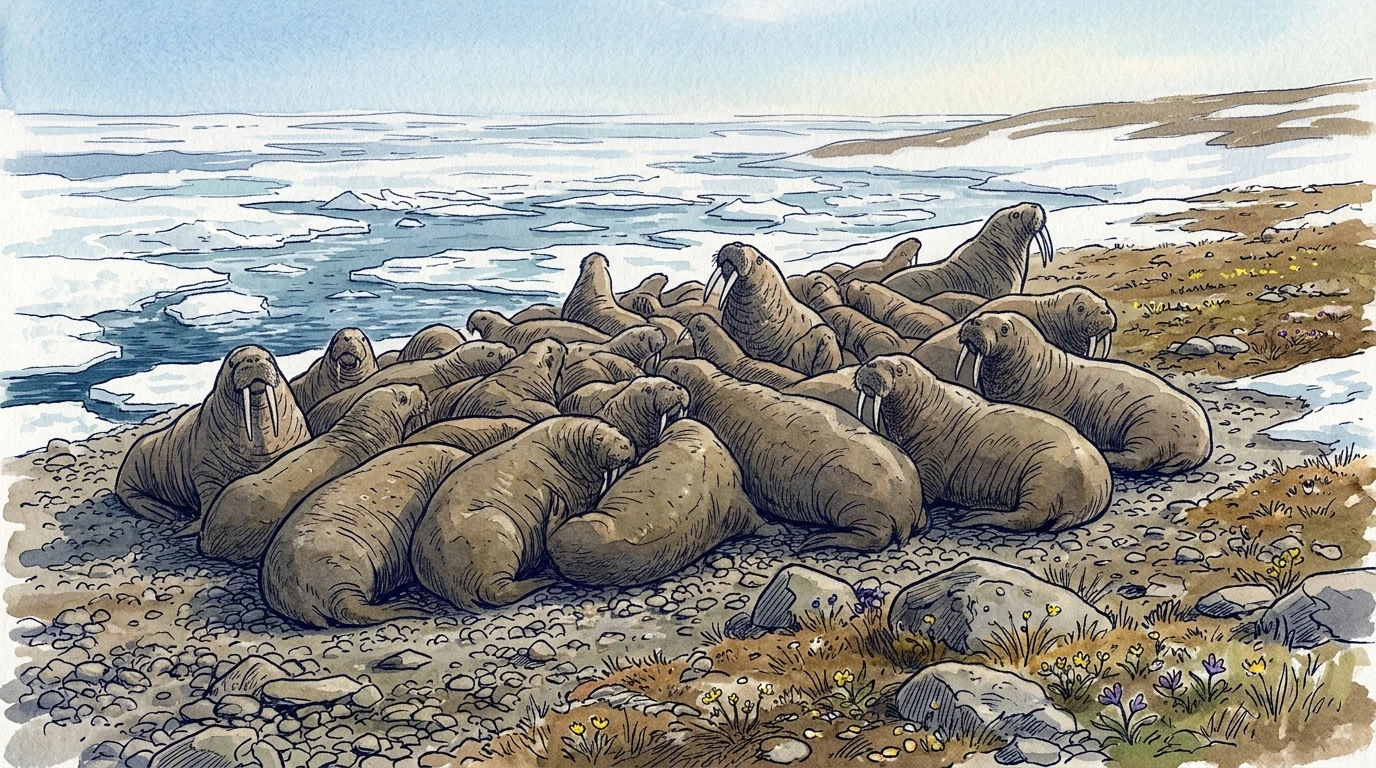
Group of walruses in a resting phase in Spitsbergen
Where to spot walruses in Spitsbergen
Low coastal areas: beaches and sand tongues
Walruses prefer easily accessible areas: shallow beaches, sandbanks, areas where they can haul out of the water with little effort. These sites are often recurrent from year to year.
From a ship, these areas are identifiable:
– low relief,
– gentle slope,
– absence of steep cliffs.
The ice edge: an ideal platform
Sea ice is a preferred support:
– resting between two feeding phases,
– direct access to food-rich areas,
– relative safety.
But this ice is mobile. An accessible area one week may disappear the next.
Proximity to shellfish-rich areas
The walrus primarily feeds on molluscs (notably clams). It forages the seabed with its whiskers.
This means that interesting areas are often:
– shallow,
– rich in sediments,
– biologically active.
Distances and approach rules from a ship
Why distance is essential
The walrus is sensitive to disturbance, especially during resting phases. A too direct approach can cause a collective rush to the water.
This movement is not trivial:
– risk of injury among individuals,
– unnecessary energy expenditure,
– lasting disturbance of the site.
The gradual approach: the only one that works
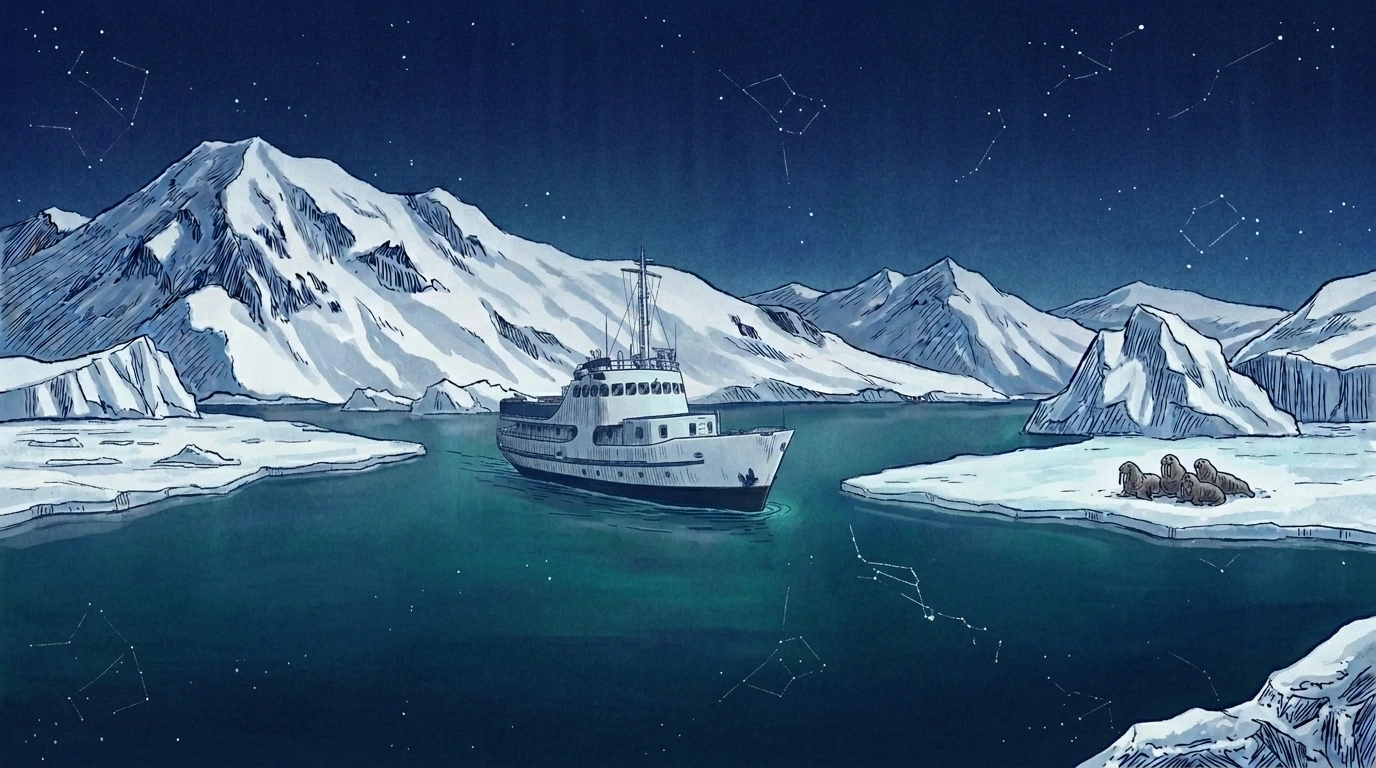
From a ship, the approach is always indirect:
– gradual reduction of speed,
– non-frontal trajectory,
– stopping at a reasonable distance,
– long observation rather than quick closeness.
What works best: allowing the walruses to 'accept' the presence of the ship.
Reading the warning signals
Certain signs indicate that you are too close:
– heads that lift simultaneously,
– agitation in the group,
– individuals heading towards the water.
At this stage, the right decision is simple: do not insist.
What really influences your chances of observation
The season: fairly stable presence, variable conditions
Walruses are present for a large part of the navigation season. What changes are the conditions:
– ice available or not,
– accessibility of coastal areas,
– weather (wind, swell).
Weather and sea: key factors
A rough sea complicates the approach:
– less precision in the trajectory,
– more difficult observation,
– discomfort on board that reduces time spent outside.
Conversely, a manageable sea allows for longer observation.
The determining factor: the time spent searching
The walrus does not 'display' itself. You need to:
– scan the coasts,
– read the reliefs,
– spotting shapes,
– accepting to see nothing for a while.
A vessel with time and flexibility increases the chances, but never guarantees.
From the vessel: what you will really see
Long, unremarkable phases… but rich
Observing the walrus is rarely “active”. We observe:
– breathing,
– discreet interactions,
– changes in position,
– entries and exits from the water.
It is an observation of patience, not movement.
Sometimes, very dynamic sequences
Certain situations accelerate:
– arrival of an individual,
– reaction to a noise,
– collective movement.
These moments are brief, but significant.
An observation that depends on your posture
Those who stay on deck for a long time, in calm, see more.
Those who pass quickly and “take a glance” see less.
The difference is not down to luck, but to the time spent paying attention.
Did you know
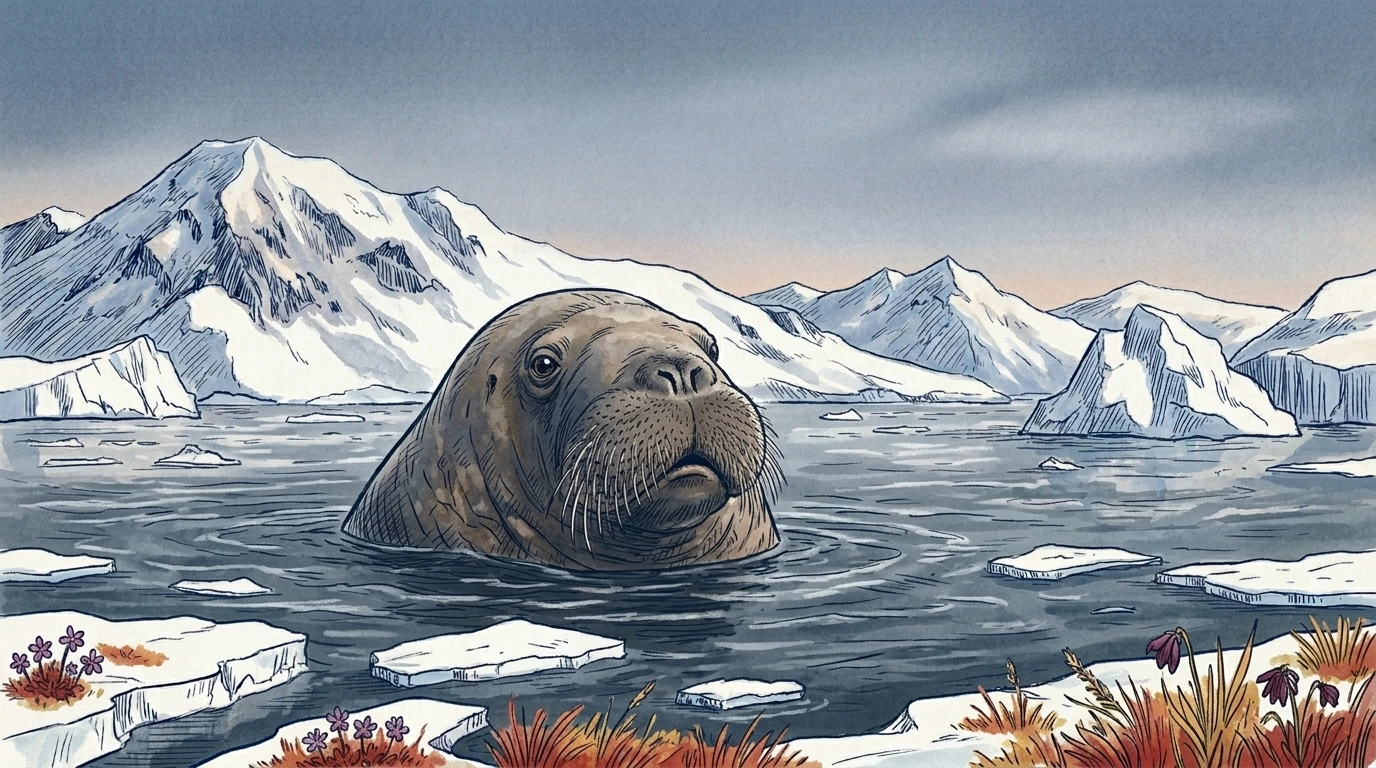
The walrus can consume several thousand shellfish a day. It literally sucks them in using powerful suction, then spits out the shells. This technique explains why it favours soft bottoms rich in bivalves, and why certain areas are frequented repeatedly.
What this observation changes in your experience
Observing a walrus is not just ticking off a species. It is understanding a balance: a massive animal, dependent on specific areas, sensitive to disturbance, perfectly adapted to a challenging environment.
From a ship, this becomes a reading of the territory:
– where to search,
– how to approach,
– when to stop.
https://www.escales-polaires.com/spitsbergen
https://www.escales-polaires.com/fr/croisieres-aventure
https://www.escales-polaires.com/blog/un-monde-deux-poles-1
Relevant external link
https://www.npolar.no/en/species/walrus/
The walrus is a remarkable encounter in Spitsbergen, but it is earned. It relies on reading the terrain, the quality of the approach, and patience. An agile ship, time, and an attentive crew make the difference. If you are looking for this type of observation, the challenge is not to go fast, but to be in the right place at the right time, and to know how to wait.